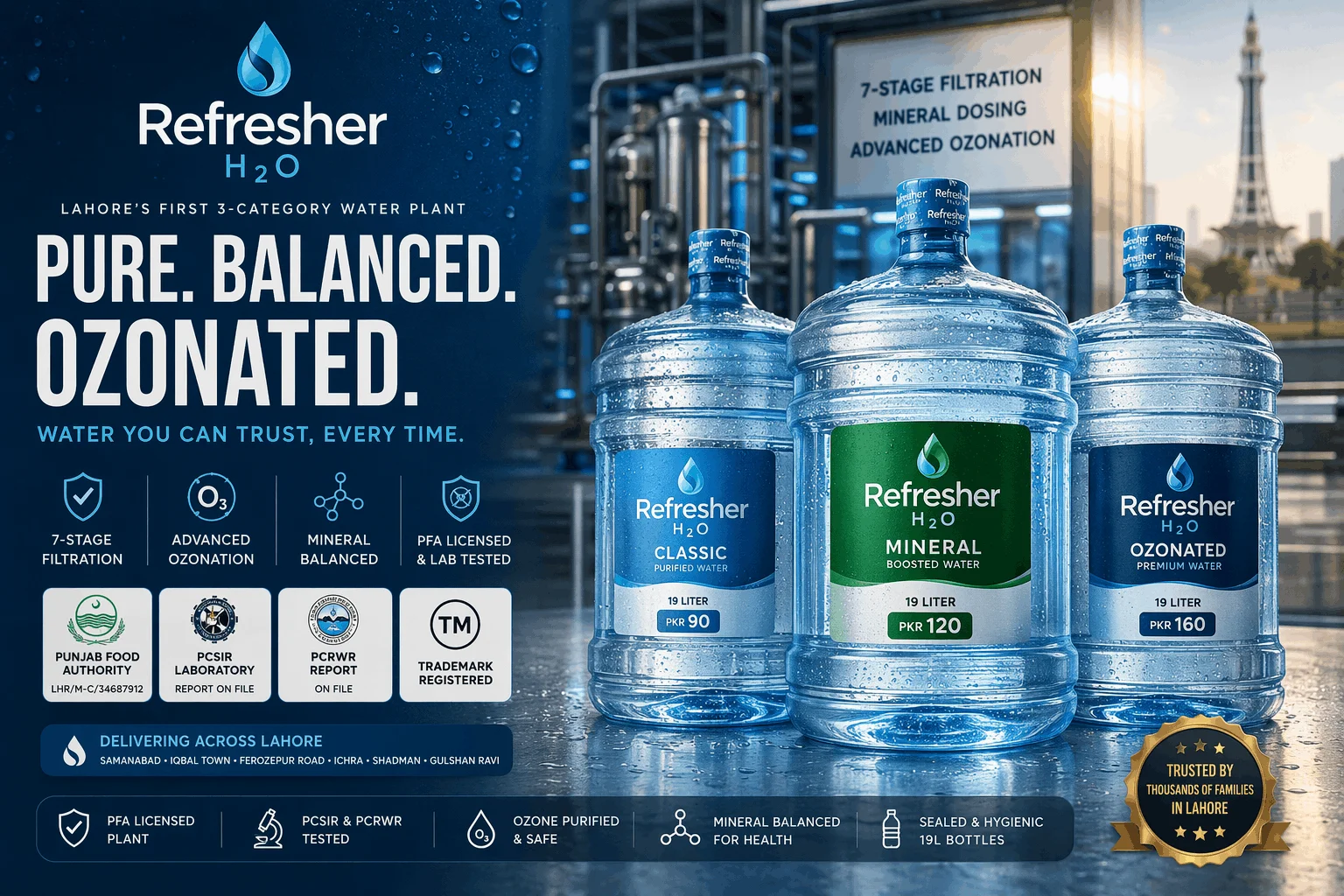
WHO estimates roughly 1 million people die every year from unsafe drinking water. In Pakistan, PCRWR and UNICEF data point to around 70% of households consuming contaminated water. This guide cuts through the noise — filtered vs mineral vs ozonated — and which red flags tell you a Lahore water plant is unsafe.
Filtered Water vs Mineral Water: Which Is Safe in Lahore?
WHO highlights the serious global risks linked to unsafe drinking water, sanitation and hygiene. In Pakistan, public reporting and water quality references point to significant contamination concerns in many areas. This guide explains what filtered water removes, why mineral boosting matters, why ozonation adds another hygiene layer, and which red flags Lahore families should check before ordering bottled water.

🛡️ Why You Can Trust This Guide
- Every statistic is cited from WHO, PCRWR, UNICEF or PCSIR — no guesses, no marketing numbers.
- Authored by Muhammad Ali — Masters in Water Studies from a London university, operating a Punjab Food Authority licensed plant (LHR/M-C/34687912).
- Plant is on the PCSIR lab report and PCRWR monitoring register — their teams sample bottled water plants on a regular rotation.
- No affiliate pushes. No fear mongering. Just what Lahore families need to know before their next bottle order.
WHO data: water kills more people than you think (and most don’t realise)
If you ask ten Lahore households whether their drinking water is “safe”, nine will say yes. The WHO data tells a very different story at a global level.
Per industry analysis of the WHO drinking water fact sheet, microbiologically contaminated drinking water can transmit diarrhoea, cholera, dysentery, typhoid and polio. The scale of preventable child mortality is particularly hard to sit with: the WHO states that the deaths of around 395,000 children under five each year could be avoided if unsafe water, sanitation and hand hygiene were addressed.
The WHO attributes approximately 505,000 diarrhoeal deaths per year to microbially contaminated drinking water. In other words, the difference between “filtered” and “properly disinfected” water is, statistically, a life and death gap for somebody’s child every single minute of the day.
The Pakistan reality: sewerage pipes next to water pipes
Pakistan’s water safety picture is sharper than most people want to admit. A 2026 PIDE seminar referencing PCRWR and UNICEF data reported that approximately 47% of Pakistanis have access to safe drinking water, with around 30–40% of national diseases — including diarrhoea, hepatitis and typhoid — attributed to unsafe water, per industry reporting on the PIDE water quality briefing.
Where does the contamination come from?
The PCRWR Quarterly Bottled Water report has spelled this out bluntly for years: piped water also gets contaminated because pipes are laid very close to sewerage lines or open drains, which causes serious waterborne diseases. Per PCRWR reporting in its bottled water quality bulletin, around 45% of Pakistani infant deaths have been attributed to diarrhoea and roughly 60% to waterborne diseases overall.
The Frontiers in Water review (2024) put it even more directly: roughly 50% of Pakistan’s diseases and around 40% of deaths are linked to poor drinking water quality, per academic analysis on the Frontiers in Water journal.
What exactly goes wrong when the water isn’t clean?
Contaminated water doesn’t just cause one disease. It’s a bouquet — and children pay the heaviest price.
| Disease | Main cause | Common symptoms | Risk group |
|---|---|---|---|
| Diarrhoea | Bacterial / viral / parasitic contamination | Watery stools, dehydration | Children under 5 (highest) |
| Cholera | Vibrio cholerae in fecal-contaminated water | Severe watery diarrhoea, rapid dehydration | All ages |
| Typhoid fever | Salmonella Typhi | Prolonged fever, weakness | Children, young adults |
| Dysentery | Shigella / amoeba | Bloody diarrhoea, cramps | All ages |
| Hepatitis A | HAV from fecal contamination | Jaundice, fatigue, liver inflammation | Children, adults |
| Giardiasis | Giardia protozoa | Bloating, diarrhoea, weight loss | All ages |
| Polio | Poliovirus (fecal-oral) | Paralysis, nerve damage | Children under 5 |
Disease list per WHO drinking water fact sheet and PCRWR water quality reports. Swipe left on mobile to view full table.
Why simple filtration is not enough in Lahore
Let us be specific. A standard RO or sediment+carbon filter does four things well:
- Removes sand, rust, dust (5-micron sediment stage)
- Strips chlorine, odours and many organic compounds (activated carbon)
- Reduces dissolved salts (reverse osmosis)
- Improves taste and clarity
Here is what standalone filtration does not do reliably:
- It does not continuously disinfect after the filter cartridge. If the storage tank or bottle is contaminated, the clean water picks up the contamination instantly.
- It does not guarantee removal of protozoal cysts such as Giardia and Cryptosporidium in every membrane scenario. Per WHO Guidelines for Drinking-Water Quality, ozone is specifically effective against these protozoa — filtration alone is not the strongest line of defence.
- It removes minerals your body needs. RO water comes out demineralised. Without mineral dosing, the body misses out on calcium, magnesium and sodium that drinking water normally contributes.
- It does nothing about the bottle itself. If the 19-litre bottle was washed with the same contaminated municipal water and then filled, you just shipped the contamination to your customer.
What ozonation actually does (in simple English)
Ozone is oxygen with three atoms instead of two — O₃. It is one of the most powerful oxidants used in water treatment. When ozone is dissolved into water, it attacks the cell walls of bacteria, viruses and protozoa and destroys them on contact. Per the WHO Guidelines for Drinking-Water Quality (Annex 5), ozone is a powerful oxidant with many uses in drinking water treatment including oxidation and disinfection.
Why the bottled water industry loves ozone
- It kills what filters miss. Industry sources note ozone is significantly more effective than chlorine at inactivating viruses, bacteria and cysts including Cryptosporidium and Giardia.
- It leaves no harmful residue. Ozone quickly converts back to oxygen. No chlorine aftertaste, no long-term chemical residue.
- It is FDA recognised. Per industry reporting on the Healthline ozonated water overview, the US FDA recognised ozone as “generally recognized as safe” in relation to bottled water in 1995.
- Global adoption. At least 3,000 cities worldwide use ozone in drinking water treatment.
| Check | Simple Filtered Water | Ozonated Water (Refresher Premium) |
|---|---|---|
| Removes sediment & chlorine | Yes | Yes |
| Inactivates bacteria & viruses after filter | Not guaranteed | Yes (ozonation layer) |
| Effective against Giardia & Cryptosporidium | Often weak | Strong (per WHO) |
| Bottle sterilisation before refill | Often skipped | Jar/bottle sterilised before washing & filling |
| Chemical aftertaste | Sometimes (chlorine) | None (ozone → oxygen) |
| Minerals added back | No | Yes (Mineral + Premium categories) |
Our jar and bottle sterilisation happens before washing and filling — not as an afterthought.
Why mineralisation matters: calcium, magnesium, sodium
When reverse osmosis strips water of particles and salts, it also strips out the minerals your body needs. Drinking water is not only a solvent — it is a quiet, daily source of essential electrolytes and co-factors.
| Mineral | Role in body | Why it matters in drinking water |
|---|---|---|
| Calcium | Bone & teeth health, muscle function, nerve signalling | Daily drinking water can contribute to calcium intake — pure RO water offers none |
| Magnesium | Over 300 enzyme reactions, muscle & nerve function, cardiac rhythm | Magnesium in water is highly bioavailable and supports daily requirement |
| Sodium | Fluid balance, nerve conduction | Controlled low-dose sodium improves taste profile without over-dosing |
General physiology roles. Individual needs vary — consult a clinician for specific medical guidance.
The key word in Refresher H2o’s mineral boosting is controlled. We do not guess. We dose with pharmaceutical grade mineral salts to hit stable category-specific targets, batch after batch.
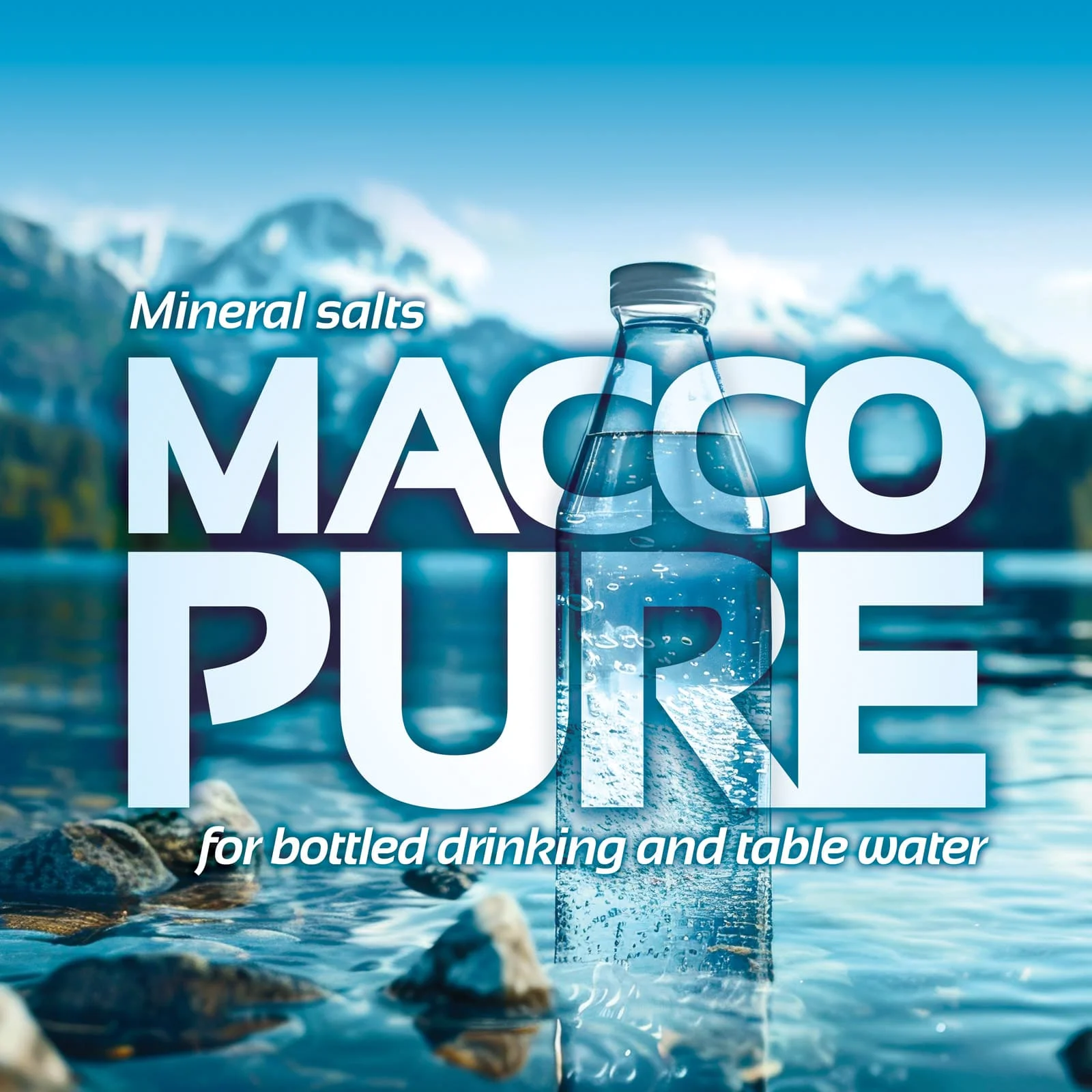
The minerals we use: Macco Organiques (Czech Republic)
Pharmaceutical grade · Halal · Kosher
Refresher H2o uses pharmaceutical grade calcium, magnesium and sodium mineral salts from Macco Organiques — a European producer based in the Czech Republic, part of Canada’s Lallemand group, serving infant formula, IV & dialysis solution manufacturers, and mineralised bottled water producers worldwide.
Per Macco Organiques’ own certification page, production runs under GMP ICH Q7, with final processing in ISO Class 8 (GMP Grade D) cleanrooms. Their mineral salts are Halal and Kosher certified, plus FSSC 22000 and ISO 9001.
Explore their portfolio on the official Macco products page.
3-way comparison: Classic vs Mineral vs Ozonated
| Dimension | Generic Filtered Water | Refresher Mineral Boosted | Refresher Ozonated Premium |
|---|---|---|---|
| Main goal | Remove impurities | Remove + mineral balance | Remove + balance + hygiene layer |
| Mineral profile | Demineralised | Controlled Ca / Mg / Na | Controlled Ca / Mg / Na |
| Final hygiene step | None | Sealed SOP only | Advanced ozonation + sealed SOP |
| Taste consistency | Drifts as filter ages | Stable batch-to-batch | Stable batch-to-batch |
| Documentation | Usually none | PFA licence + PCSIR + PCRWR | PFA licence + PCSIR + PCRWR |
| Refresher price (19L) | — | PKR 120 | PKR 160 |
Classic Refresher Purified sits between “generic filtered” and “mineral” — it runs the full 7-stage filtration (including UV), but without the mineral dosing step. Priced at PKR 90 for 19L.
🚨 Red flags: how to spot an unsafe Lahore water plant
Before your next order — whether from us or anyone else — run this quick check. Any vendor that fails three or more of these should be off your list.
- No PFA licence number on request. A genuine bottled water plant in Punjab shares its Punjab Food Authority licence number without hesitation.
- No lab reports mentioned. If they cannot reference PCSIR or PCRWR sampling, who is verifying their water?
- Silent on ozonation. “We filter the water” is not a hygiene plan. Ask what the final disinfection step is.
- No bottle sterilisation SOP. Ask how they sterilise the 19L jar before washing and filling. Vague answers = skip.
- Demineralised end water. If they cannot tell you whether the output is RO-only or mineral balanced, the output is probably RO-only.
- Mismatched seals. Broken caps, reused bottle caps, or tape-wrapped caps are contamination vectors.
- Ultra-cheap one-time delivery. Sustainable safety has a floor cost. If a bottle is dramatically cheaper than the market, shortcut economics are funding it.
Our licences & reports (the authorities visit us regularly)
We do not ask customers to take our word for it. Lahore regulators send sampling teams on their own rotation — and here is what they confirm about Refresher H2o.
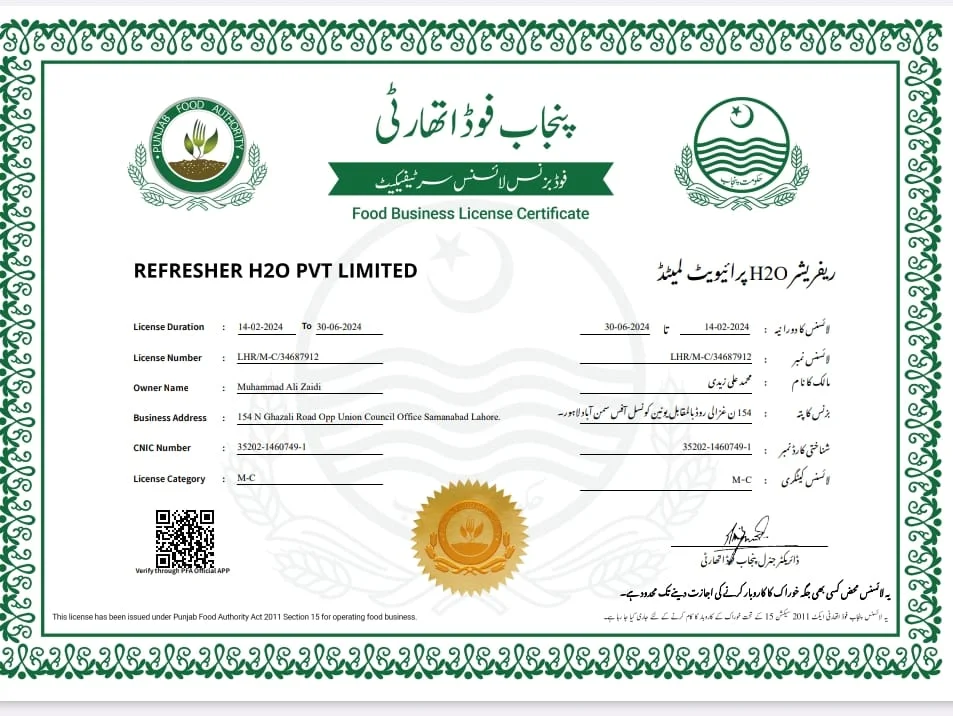 Punjab Food Authority
Licence LHR/M-C/34687912
Punjab Food Authority
Licence LHR/M-C/34687912
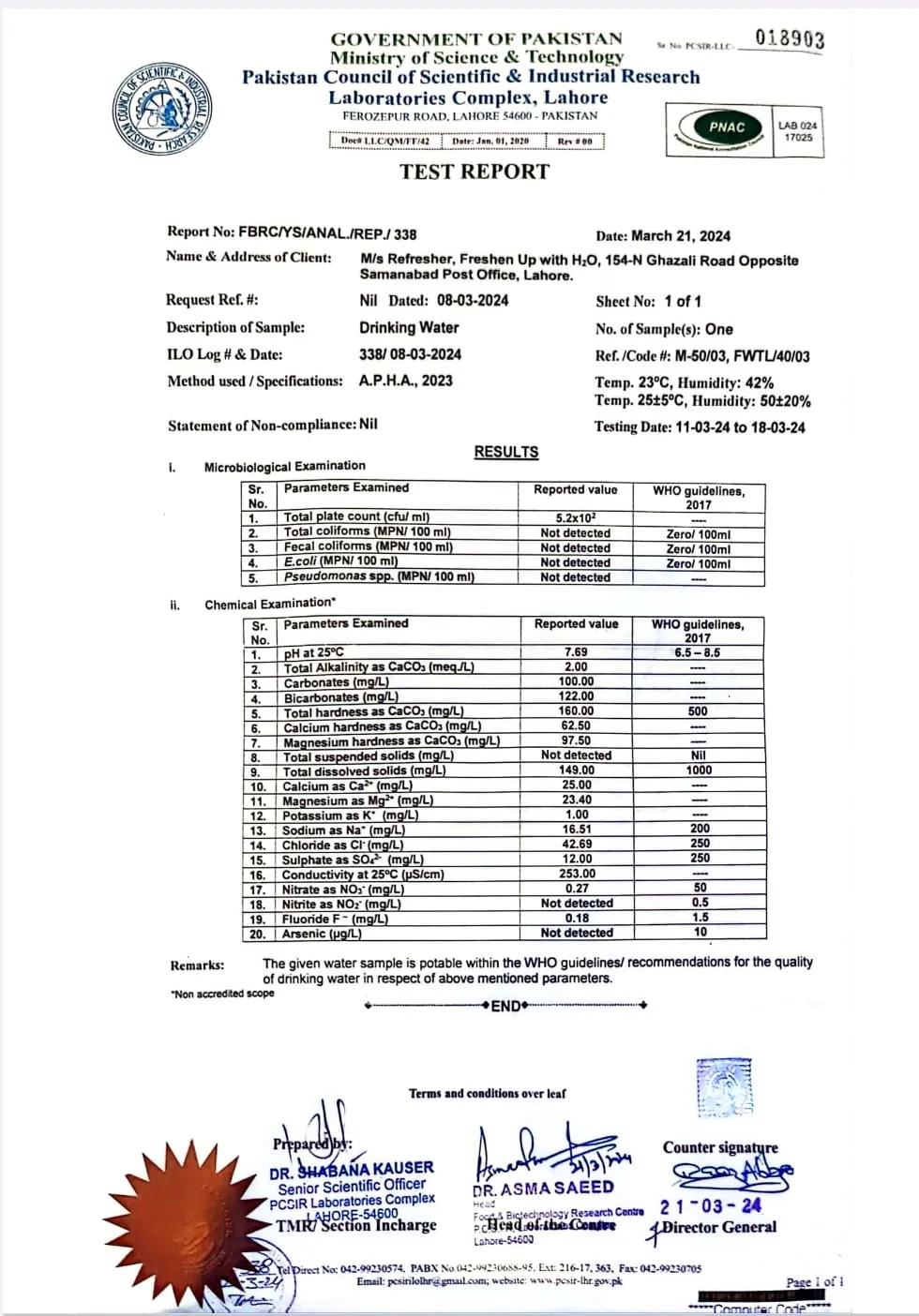 PCSIR Laboratory
Water analysis report on file
PCSIR Laboratory
Water analysis report on file
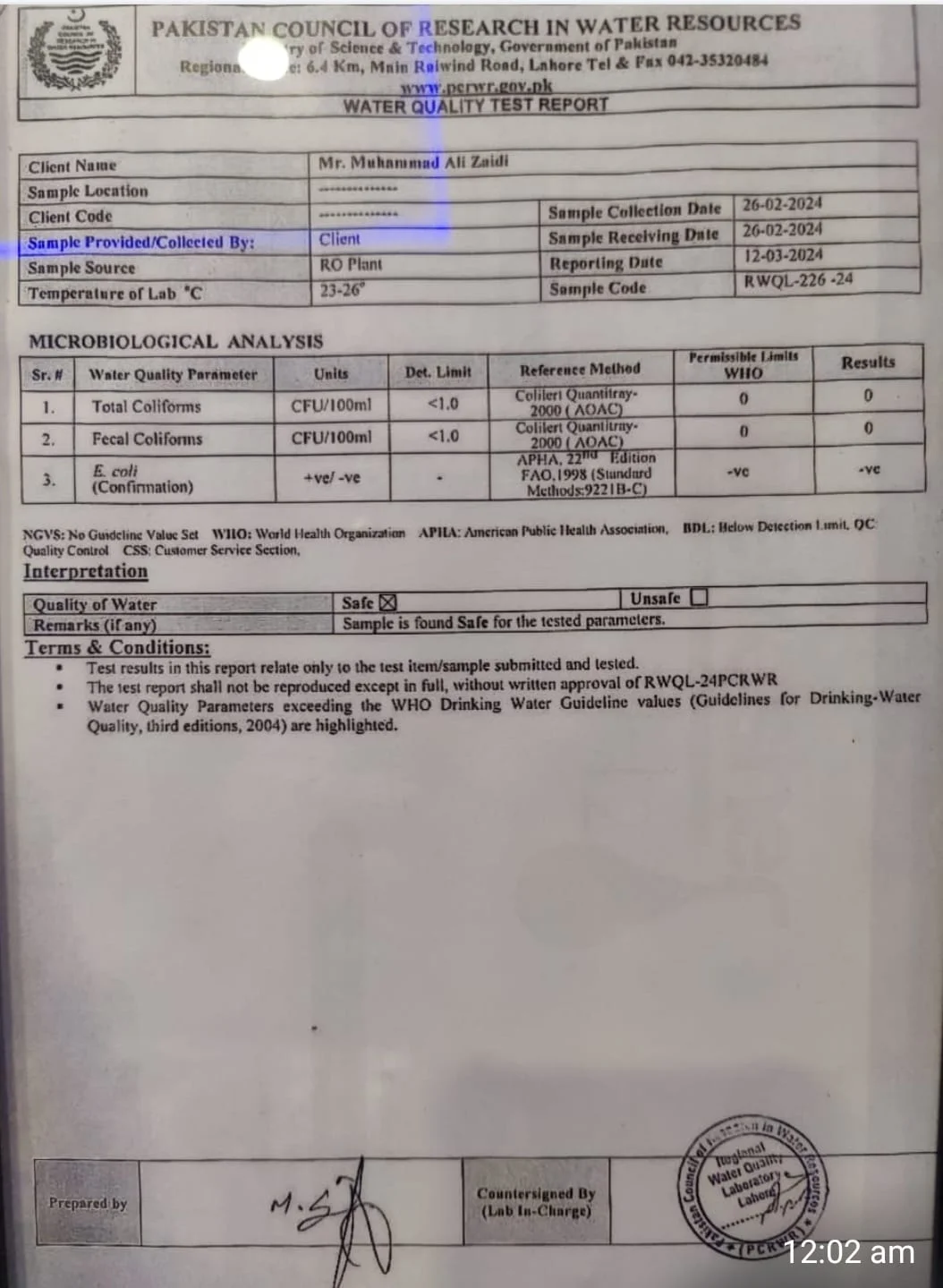 PCRWR Report
Quality alignment on file
PCRWR Report
Quality alignment on file
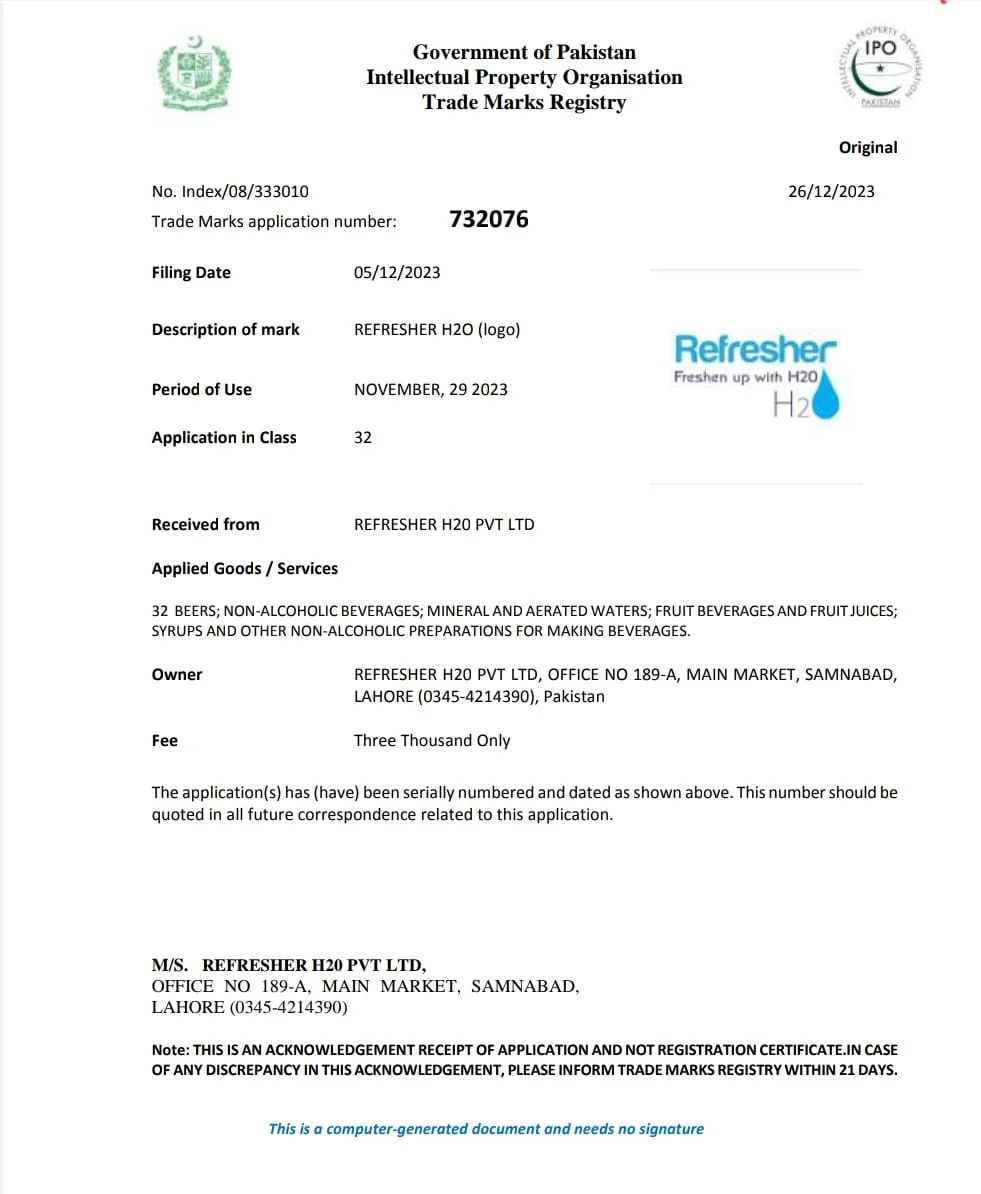 Trademark Registered
Refresher H2o™ brand
Trademark Registered
Refresher H2o™ brand
Our methodology (what “safe” actually means here)
🧪 How every Refresher H2o bottle is prepared
- Sediment filtration — 5 micron removal of sand, dust, particles.
- Activated carbon — chlorine, odours, organic compounds.
- 1 micron polish — final fine particulate catch.
- Reverse osmosis — dissolved salts and heavy metals.
- UV sterilisation — residual microbial load.
- Mineral dosing (Mineral & Premium) — Macco Organiques pharmaceutical grade Ca / Mg / Na.
- Advanced ozonation (Premium) — final hygiene layer.
- Jar & bottle sterilised before washing and filling — hygiene SOP non-negotiable.
- Sealed dispatch — tamper-evident cap, logged route.
Daily chemist batch testing: TDS, pH, microbial load, ozonation residual, sensory, seal integrity — logged, dated, archived. This is a cost-basis directional range discipline, not a one-off compliance stunt.
Case study: a Samanabad family who switched
Problem: Recurring stomach upset in the two youngest children. Vendor was a local “filter” plant with no visible PFA licence and no ozonation. Bottles arrived with inconsistent cap seals.
Intervention (week 1–2): Switched to Refresher Classic Purified at PKR 90 — the same stage line minus mineral dosing. Immediate taste complaint dropped because chlorine residue was gone.
Month 2: Upgraded to Mineral Boosted at PKR 120 for daily drinking. Two adults on mild hypertension protocols reported the balanced mineral profile was easier to drink consistently than the previous brand’s high-TDS output.
Case drawn from a Samanabad Lahore household. Names withheld. Anecdotal customer experience only, not a medical claim or clinical result.
“Pehle hum samajhte the sab filtered water same hota hai. Refresher pe teen categories try karne ke baad pata chala ke filtered, mineral aur ozonated teenon alag cheezein hain. Ab bachon aur mehmaano ke liye Premium chalta hai.”
Case drawn from a Samanabad Lahore household. Names withheld. Directional experience, not a medical claim.
💡 Ready-to-use AI prompts (for Lahore households)
Copy these into ChatGPT, Gemini or Claude before picking a water plant:
Prompt 1 — Compare vendors like a scientist
For comparing any Lahore water delivery vendor to a three-category plant.
Prompt 2 — Decide which category fits your home
Classic (PKR 90), Mineral (PKR 120) or Ozonated (PKR 160)?
About the author
Muhammad Ali
Founder of Refresher H2o, Samanabad Lahore. Master’s degree in Water Studies from a London university. Specialises in seven-stage filtration, mineral dosing with pharmaceutical grade salts and advanced ozonation for home and office water delivery. Operates under Punjab Food Authority licence LHR/M-C/34687912.
📚 Sources & further reading
- World Health Organization. Drinking-water fact sheet.
- WHO. Guidelines for Drinking-Water Quality — Annex 5: Treatment methods and performance.
- PCRWR. Drinking Water Quality in Pakistan — Current Status and Challenges.
- PCRWR. Bottled Water Quality Quarterly Report.
- PIDE seminar coverage, December 2025 — “Only 47% Pakistanis have access to safe drinking water”.
- Frontiers in Water, 2024 — Water management and sustainable development in Pakistan.
- Macco Organiques — Certification page and Products page.
- Healthline — Ozonated Water overview referencing FDA GRAS designation.
- Our World in Data — Clean Water: global deaths and access.
Statistics cited are directional ranges from peer-reviewed or government sources. Figures evolve annually.
❓ FAQ
Filtration reduces particles and chlorine, but does not guarantee microbial safety. PCRWR and UNICEF data show roughly 70% of Pakistani households consume contaminated water, often because supply pipes run close to sewerage lines. A filter alone cannot undo sewerage mixing — a final disinfection step such as ozonation is the meaningful safety layer.
Filtered water focuses on removal — sediment, chlorine and many impurities. Mineral boosted purified water is purified water that is then dosed with controlled sodium, calcium and magnesium for taste and balance. Refresher Classic is purified (PKR 90), Mineral Boosted adds pharmaceutical grade dosing (PKR 120), and Ozonated Premium adds a final ozonation layer (PKR 160).
Per WHO Guidelines for Drinking-Water Quality, ozone is a powerful oxidant effective against bacteria, viruses and protozoa including Cryptosporidium and Giardia. It decomposes back to oxygen, leaving no chlorine-like residue or aftertaste. The FDA recognised ozone as generally safe for bottled water in 1995.
Refresher H2o uses pharmaceutical grade calcium, magnesium and sodium mineral salts from Macco Organiques, Czech Republic. Per Macco’s certification page, their salts are Halal and Kosher certified, produced under GMP ICH Q7, FSSC 22000 and ISO 9001.
Ask five questions: PFA licence number, PCSIR/PCRWR cooperation, final disinfection step, mineral source, bottle sterilisation SOP. Any vendor that cannot answer three of these clearly is a red flag.
We deliver in Samanabad, Iqbal Town, Ferozepur Road, Ichra, Shadman and Gulshan Ravi. Classic PKR 90, Mineral PKR 120, Ozonated Premium PKR 160 — plus a one-time PKR 30 reusable bottle charge on first delivery.
Ready to upgrade your family’s water?
Move from unknown filter water to a PFA licensed supply with purified, mineral boosted and ozonated options. Book once and we will handle the route.
Leave a Reply